

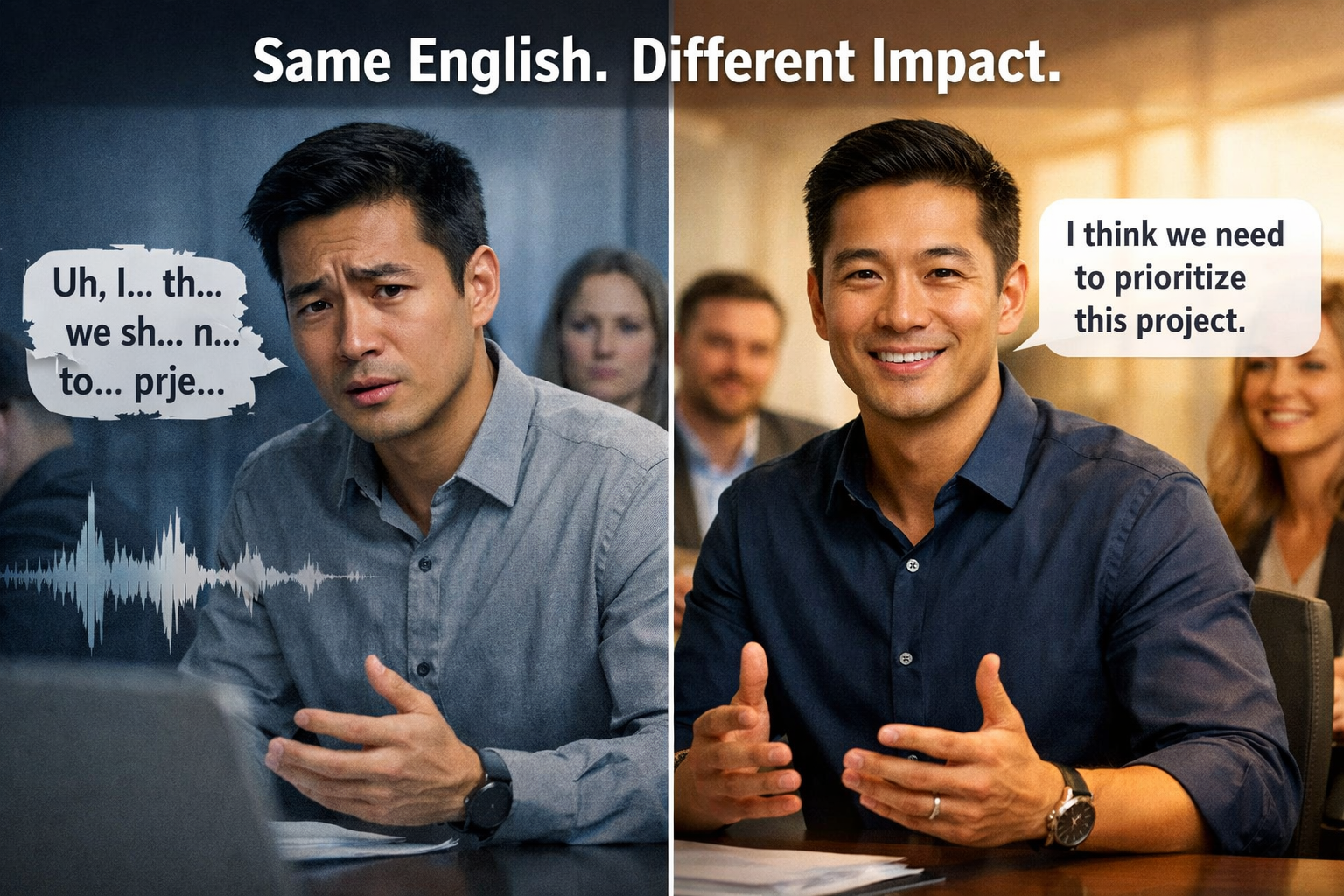
Let’s get something straight right away:
You don’t have a “bad” level of English.
You’re educated. You communicate every day. You get your point across—most of the time. You’ve probably been told your English is “good” or even “very good.”
And yet… something isn’t landing the way it should.
You hesitate before speaking.
People ask you to repeat yourself more than you’d like.
Your ideas don’t seem to carry the weight they deserve.
In meetings, you hold back—even when you know exactly what needs to be said.
This is the frustrating middle ground:
Your English is good enough to function, but not strong enough to perform.
And in a professional environment, that gap matters more than you think.
The Real Problem Isn’t Your English—It’s Your Delivery
Most people assume the issue is vocabulary or grammar.
It’s not.
You already know what you want to say. You’re not searching for words. You’re not forming sentences incorrectly.
The real issue is how your speech is being processed by other people in real time.
That comes down to three things:
- Clarity – Are your words easy to understand the first time?
- Consistency – Do you sound the same under pressure as you do when you’re relaxed?
- Professional Presence – Do you sound confident, decisive, and credible?
When those three elements are even slightly off, the impact is immediate:
- People stop listening as closely
- They ask for repetition
- They interrupt or talk over you
- They underestimate your expertise
Not because you lack ability—but because your delivery creates friction.
And in fast-moving professional environments, friction kills momentum.
Where This Shows Up (Even If You Try to Ignore It)
You may not think about it constantly, but it shows up in very specific moments:
Meetings
You have something valuable to say—but you wait.
Not because you don’t know what to say, but because you’re not 100% confident in how it will sound.
That hesitation costs you visibility.
Presentations
You prepare. You know your content.
But while speaking, part of your attention is split:
- “Am I saying this clearly?”
- “Did they understand that?”
- “Should I repeat that?”
Now you’re managing delivery instead of leading the room.
One-on-One Conversations
You explain something once… then again… then simplify it.
You adjust your speech mid-conversation to make sure you’re understood.
That’s cognitive load you shouldn’t have to carry.
High-Stakes Moments
Interviews. Performance reviews. Leadership conversations.
These are the moments where clarity and confidence matter most—and where even small breakdowns have a bigger impact.
The Cost (That No One Talks About)
This isn’t just about pronunciation.
It’s about how you’re perceived.
When your speech isn’t fully clear and consistent:
- You sound less certain than you are
- Your ideas feel less immediate and less sharp
- Your authority gets diluted
And over time, that affects:
- Promotions
- Leadership opportunities
- Influence within your team
Here’s the uncomfortable truth:
You can be the smartest person in the room—and still not be seen that way.
Why You Haven’t Fixed This Yet
You’ve probably tried to improve.
Most people in your position have.
You’ve used apps. Watched videos. Maybe even taken classes or worked with a coach.
So why hasn’t it fully clicked?
Because most solutions are built around the wrong model.
Problem #1: Generic Content
Most programs teach the same material to everyone:
- all sounds
- all rules
- all patterns
But your challenges are specific.
You don’t need everything.
You need the few patterns that actually affect your clarity.
Problem #2: Passive Learning
Watching videos, listening to examples, reading explanations…
That feels productive—but it doesn’t change how you sound.
Understanding something is not the same as being able to do it consistently.
Problem #3: No Real Feedback
If no one is correcting you in real time, you’re guessing.
And when you guess, you often reinforce the exact patterns you’re trying to fix.
Problem #4: No Transfer to Real Speech
You might sound better in practice drills.
But then you get into a real conversation—and everything falls apart.
Why?
Because you weren’t trained to perform under real conditions.
The Hidden Problem: You’re Practicing the Wrong Way
This is where most people get stuck.
They think:
“I just need to practice more.”
But if the practice is unfocused or incorrect, more of it doesn’t help.
It makes things worse.
You end up:
- repeating the same errors
- building habits that are hard to break
- getting frustrated because effort isn’t producing results
The goal is not more practice.
The goal is better, more targeted practice.
What Actually Moves the Needle
If you want real improvement, the process has to change.
Here’s what works:
1. Focus on High-Impact Patterns
You don’t need to fix everything.
You need to fix:
- the sounds you use most often
- the patterns that cause misunderstanding
- the features that affect how confident you sound
This is about leverage, not completeness.
2. Train Prosody Early
This is where most people miss the mark.
Prosody includes:
- stress
- rhythm
- intonation
It’s not just what you say—it’s how your speech flows.
You can have imperfect sounds and still sound clear and confident.
But if your rhythm and stress are off, your speech feels unnatural immediately.
3. Build Real-World Performance
You don’t just practice words and sentences.
You train for:
- meetings
- explanations
- spontaneous speech
Because that’s where it matters.
4. Use Tight Feedback Loops
You need to know:
- exactly what’s wrong
- exactly how to fix it
- exactly when you’ve improved
Without that, you’re guessing.
5. Stay Consistent (Short, Daily Reps)
Long sessions don’t work for busy professionals.
What works:
- 10–15 minutes a day
- focused repetition
- consistent execution
That’s how habits change.
What Changes When You Get This Right
When your clarity and delivery improve, the shift is immediate.
You’ll notice:
- You speak without hesitation
- People understand you the first time
- You don’t need to repeat yourself
- Your ideas land faster and more clearly
- You sound more confident—even when you’re not trying to
And other people notice too.
They may not say:
“Your pronunciation improved.”
But they will respond differently:
- more engagement
- more trust
- more attention
That’s the real outcome.
Two Paths Forward (Depending on How You Want to Work)
At this point, you have two options.
Both are built around the same system—but with different levels of support and accountability.
Option 1: Accent Clarity Foundations™
This is the structured, self-directed path.
You get:
- a clear lesson sequence
- language-specific training paths
- targeted instruction on high-impact patterns
This is for you if:
- you prefer to work independently
- you can stay consistent on your own
- you’re willing to apply what you learn without external correction
It gives you the system.
But execution is on you.
Option 2: Accent Clarity Accelerator™
This is the full, guided experience.
You get:
- diagnostic analysis of your specific speech patterns
- a customized training plan
- 1-on-1 coaching sessions
- real-time correction and feedback
- measurable progress tracking over 8–12 weeks
This is for you if:
- you want faster, more precise results
- you don’t want to guess what to fix
- you value accountability and expert guidance
This is where the biggest changes happen—because you’re not doing it alone.
The Key Difference
It’s simple:
- Accent Clarity Foundations™ = Access to the system
- Accent Clarity Accelerator™ = Execution with guidance and accountability
Both work.
But they require different levels of commitment.
The Decision You Need to Make
You don’t need more information.
You don’t need another video, another tip, or another explanation.
You need to decide:
Are you ready to actively work on how you sound—or are you going to keep working around it?
Because staying where you are has a cost.
It shows up in:
- missed opportunities
- reduced confidence
- less influence than you should have
And it doesn’t fix itself over time.
Final Thought
Your English is not the problem.
Your intelligence is not the problem.
Your ideas are not the problem.
The gap is in execution under real conditions—and that’s a skill you can train.
But only if you move from passive learning to focused, consistent action.
If you’re ready to sound as capable as you actually are, the path is clear.
The only question is whether you’re willing to take it.